Guide
How to Name Your Product: A Step-by-Step Guide
How to name your product in a week: write a naming brief, generate 100+ ideas, filter them hard, check trademarks and domains, then test with real buyers.
Updated Nov 2, 2026 · 12 min read
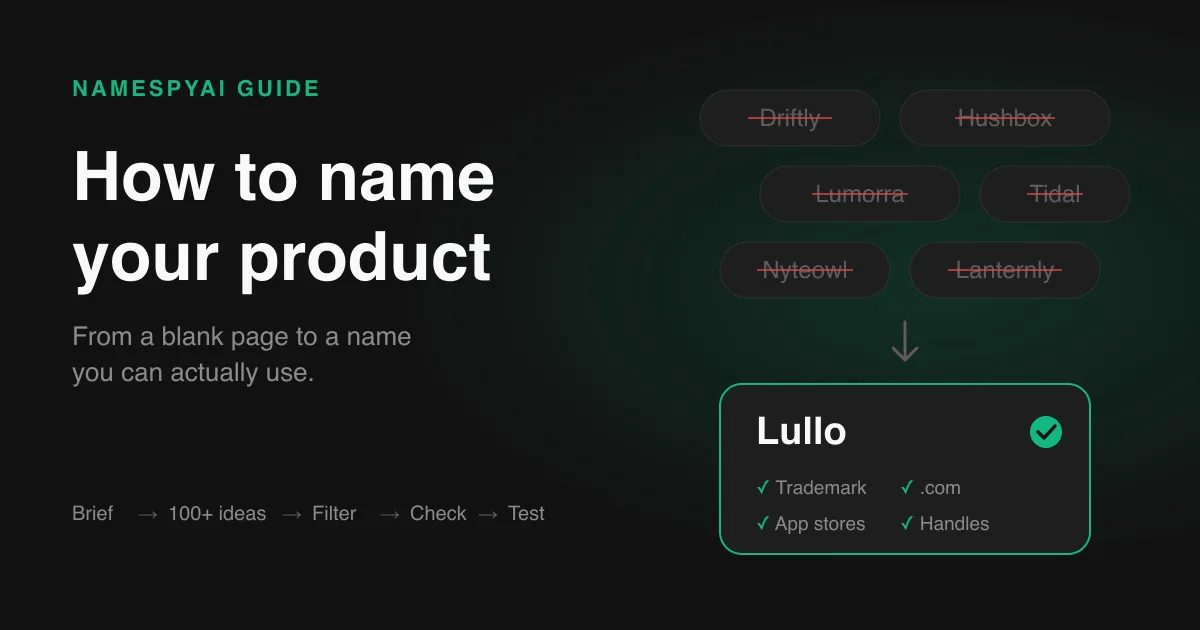
Most naming advice tells you to "be memorable" and "keep it short," which is true and not much help when you're staring at a blank page. This guide is the process we'd use ourselves: write a short brief, generate a long list on purpose, cut it with a few hard filters, check what's actually available, and only then ask people what they think. It works for physical products, apps and SaaS, and there's a section near the end on naming features inside a software product, which is a different problem.
Write a naming brief before you write any names
Brainstorming without a brief produces names you like, which isn't the same as names that work. Spend twenty minutes answering these in writing:
- What does the product do, in one sentence? Not the vision. The thing a customer would say to a friend.
- Who buys it? A developer tool, a skincare line and a kids' app need very different sounds.
- Where will people first see or hear the name? An App Store search result, a podcast ad, a shelf, a word-of-mouth recommendation. Spoken-first names have to survive being heard once.
- Which markets and languages matter in the next three years? This decides which trademark offices you search and which translations you check.
- Will the product line grow? If you sell one candle today and plan a home fragrance brand, "WickBox" will box you in.
- Three words for how it should feel. Calm, fast, playful, serious, premium, cheap and cheerful. Pick three and stick to them.
Keep the brief open while you work. When two people on the team argue about a name, the brief settles it faster than taste does.
Decide what kind of name you want
Product names fall into a handful of types. Each one trades something away.
- Descriptive names say what the product is: General Motors, Booking.com, Dropbox. Customers understand them instantly. They're also the hardest to protect, because trademark law doesn't let you own plain descriptions of your product category.
- Suggestive names hint at a benefit without stating it: Netflix, Pinterest, Mailchimp. This is the sweet spot for most startups. The name gives a clue, and it's distinctive enough to register.
- Arbitrary names are real words with no link to the product: Apple for computers, Shell for fuel. They're easy to say and easy to protect, but you have to spend money teaching people what the word means for you.
- Coined names are invented: Kodak, Xerox, Häagen-Dazs. George Eastman reportedly built Kodak around the letter K because he liked how firm it sounded. Reuben Mattus made up Häagen-Dazs in the Bronx to sound Scandinavian. Coined names are the strongest trademarks and the most likely to have a free .com, but they carry no meaning on day one.
- Compound names join two words: Facebook, Snapchat, YouTube. They can feel descriptive and distinctive at once, though good combinations get taken quickly.
- Founder names like Ford or Dyson work when the founder is part of the story. They're harder to sell later if the company changes hands.
That descriptive-to-coined line follows how US trademark law ranks distinctiveness: generic terms can't be registered at all, descriptive ones need proof that customers already link the term to you, and suggestive, arbitrary and coined names can usually be registered from the start. If you plan to defend the name, lean right on that spectrum.
Generate a long list on purpose
Aim for 100 to 200 candidates before you judge any of them. Judging too early kills the strange ideas that sometimes turn into the best names. Some techniques that reliably produce material:
- Mine your brief. List every noun, verb and image connected to what the product does and how it should feel. A sleep app might give you night, drift, hush, lull, owl, tide, lantern.
- Borrow from a source domain. Pick an unrelated field (astronomy, sailing, botany, music) and pull words that carry the feeling you want. Amazon, Oracle and Atlassian all came from somewhere else.
- Combine and clip. Join two words, then cut letters until it sounds like one word: Pinterest from pin and interest, Instagram from instant camera and telegram.
- Change a letter or a sound. Lyft, Tumblr and Flickr did this. It helps with availability but costs you spelling, which you'll test later.
- Use a different language, carefully. Latin and Greek roots work well (Volvo is Latin for "I roll"). Check that the word means what you think it means to native speakers today.
- Use a generator for volume. A product name generator can give you fifty options from a short description in a few seconds. Treat the output as raw material to combine and edit, not a shortlist.
Write everything down in one list. Don't explain or defend entries yet.
Cut the list with hard filters
Now get strict. Run every candidate through these filters, and drop it the moment one fails.
The radio test. Say the name out loud to someone who hasn't seen it written, then ask them to type it. If they can't spell it after hearing it once, word of mouth will send customers to the wrong place. This is where most clever misspellings die.
The pronunciation test. Ask three people to read it aloud without help. If you get three different pronunciations, people will be embarrassed to recommend it.
Length. Two or three syllables is a good target. Longer names get shortened by customers anyway, and you don't get to pick the nickname.
Meaning in your target languages. Search the name with "meaning" and the language, and ask a native speaker in each market. A word that's neutral in English can be slang, a medical term or a rude joke somewhere else.
Fit with the brief. Does it match your three feeling words? Would it still fit if the product line grew the way you expect?
Search noise. Google the name. If the first two pages are filled with a famous film, a common word or a large company, you'll fight for attention on your own name for years.
After this pass most teams are left with 10 to 20 names. That's the right size for the next step.
Check that the name is actually free
A name you can't use isn't a name. Before you get attached, check the places where a conflict would cost you money or force a rename.
Trademarks first. This is the only check that can legally force you off a name. Search the USPTO for the US and EUIPO eSearch for the EU. Look for live marks in your goods-and-services class, and search spelling and sound variations, not only the exact name. Microsoft had to rename SkyDrive to OneDrive in 2013 after losing a trademark case to British broadcaster Sky. That's a large company with a large legal team, and it still happened.
Domains. Check the .com and the extension you'd actually use (.io, .app, .co). If the .com is taken, look at what's on it. A parked domain might be for sale. An active business in your space is a warning sign whatever extension you pick.
App stores. If you're shipping on mobile, search the App Store and Google Play. Store search is fuzzy, so a similar name can bury your listing below an established app.
Social handles. Look at X, Instagram, TikTok, YouTube, LinkedIn and anywhere else your customers spend time. You don't need every handle to be an exact match, but you want one consistent pattern, like @getname or @nameapp, that you can claim everywhere.
Developer namespaces. For software, check GitHub organizations and package registries like npm. A taken package name is a small daily annoyance for your users.
Existing products. Search Product Hunt and Crunchbase. Someone may have launched under the same name two years ago and stopped updating it, and that product will still rank above yours.
Doing this by hand for 15 names means visiting about a dozen sites per name, which is a long afternoon. We built NameSpyAI to run those checks at once: USPTO and EUIPO trademarks, domains, both app stores, social platforms, GitHub, npm, Product Hunt and Crunchbase, with an AI summary of what the results mean for your name. You can also try the free product name checker on a single name first. Whichever way you do it, finish this step before you show anyone a logo. For a deeper walkthrough of each check, see how to validate a product name before launch.
A database search is a screening step, not legal advice. If a name passes your checks and you're about to spend real money on it, paying a trademark attorney for a clearance search is cheap insurance.
Test the finalists with real people
You should now have three to five names that are clear and available. Test them with people who look like your customers, not with your co-founder or your parents.
Show each person a short description of the product and the list of names, then ask:
- Which name would you remember tomorrow?
- What do you think a product with this name does?
- Which one would you be comfortable saying out loud to a colleague?
The second question matters most. If people guess a completely different product, the name is working against you. Don't ask "which one do you like?" Liking is easy to give and tells you very little.
A cheap version is to run the same ad with each name for a few days and compare click-through rates. It won't settle the choice, but a large gap is worth taking seriously.
Naming a software product
Software adds a few problems of its own.
The product name has to work as a URL, a package name and a command. If developers will type it, npm install yourname and yourname --help should both look reasonable. Avoid names that collide with common shell commands or popular libraries.
Plan for the "app" suffix. Many app names end up as "Name: Short Description" in the stores. Pick a name that still reads well with a few words after it.
Naming areas within your software product is a different job. Features, plans and sections of an app need clarity much more than personality. "Reports" beats "Insight Hub." "Team plan" beats "Galaxy tier." Users scan menus looking for the word they already have in their head, and a clever feature name makes them stop and think. Save the creativity for the product name and maybe one signature feature you want people to talk about. Slack's name came from "Searchable Log of All Communication and Knowledge," but its features are called channels, threads and huddles, which almost anyone can follow.
Keep a naming system. Decide early whether features are plain nouns ("Calendar"), verbs ("Schedule") or branded names. Mixing styles makes the product feel unplanned.
Common mistakes
- Falling in love before checking. The team picks a name on Friday, the designer makes a logo on Monday, and the trademark search happens on Wednesday. Check first.
- Buying the domain before choosing the name. A cheap domain is a bad reason to pick a name. Domain availability is one filter, not the starting point.
- Naming for the current feature. A name tied to one feature becomes awkward when the product grows. That's a large part of why companies rename.
- Voting by committee. Twelve people voting will pick the least objectionable option. Use the brief and the customer tests to decide, and have one person own the final call.
- Ignoring how it sounds. If you have to spell your name every time you say it, that's a cost you'll pay in every sales call for years.
- Treating availability as a yes or no. A taken .com with a parked page, a dead trademark and an empty Instagram account isn't the same risk as a live trademark in your class. Look at what's actually there.
A one-week naming plan
If you want a schedule:
- Day 1: Write the brief.
- Day 2: Generate 100+ names.
- Day 3: Run the hard filters and get down to 10–20.
- Day 4: Check trademarks, domains, stores and handles. Get down to 3–5.
- Day 5–6: Test the finalists with 10 or more target customers.
- Day 7: Decide, then register the domain and handles the same day.
Claim everything as soon as you decide. Names that clear every check today can be gone a month from now.
Frequently asked questions
How do I come up with a name for my product?
Write a one-page brief covering what the product does, who it's for and how it should feel. Then generate 100 or more names using words from that brief, borrowed words from unrelated fields, combinations and a name generator. Cut the list with spoken tests and availability checks rather than picking favourites early.
How do I choose a brand name for my product?
Choose the name that passes the radio and pronunciation tests, has no live trademark conflict in your class and markets, has a usable domain and handles, and makes target customers guess roughly what you do. If more than one name passes, pick the one that leaves the most room for the product to grow.
Should my product name describe what it does?
Not completely. Fully descriptive names are easy to understand but hard to trademark and easy for competitors to copy. A suggestive name that hints at the benefit usually works better.
How long should a product name be?
One word and two or three syllables is a good target. Short names are easier to remember, type and fit on packaging, and people shorten long names anyway.
What if the .com is taken?
Look at what's on it. If it's parked, ask the owner what they want for it. If it's an active business in your field, treat that as a conflict and move on. Otherwise a prefix or suffix (getname.com, nameapp.com) or a different extension can work, as long as trademarks and handles are clear.
Do I need a lawyer to name my product?
You can do the first screening yourself in the USPTO and EUIPO databases. Before you invest heavily in packaging, ads or a launch, a trademark attorney's clearance search is worth the fee.