Guide
Best App Name Generators (and How to Check the Name You Get)
An app name generator gives you fifty ideas in seconds. Here are the ones worth using, and the checks a generated name still needs before it goes on an App Store listing.
Updated Nov 12, 2026 · 6 min read
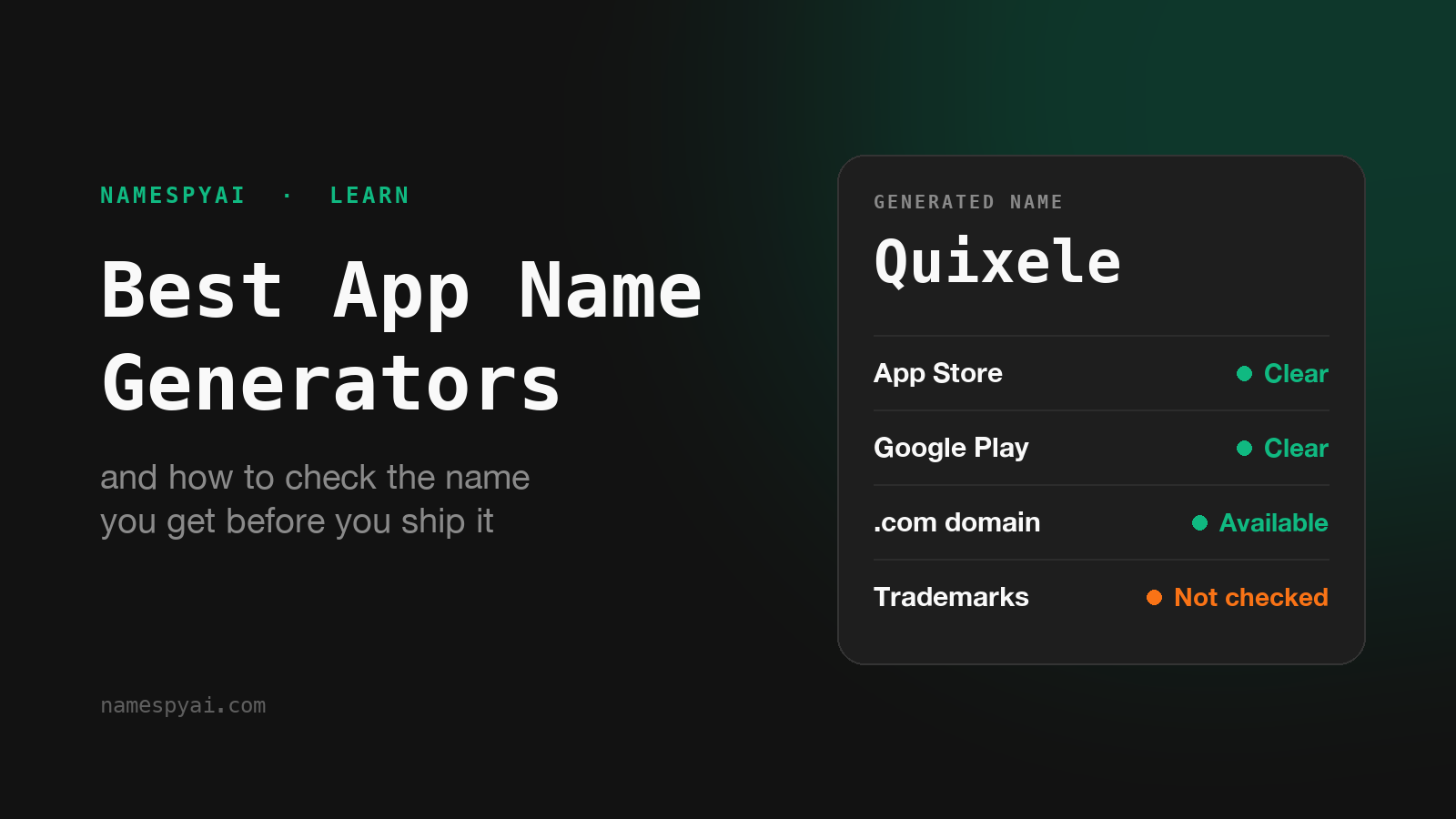
An app name generator can give you fifty candidates in ten seconds. What it can't tell you is whether any of them are safe to ship. This guide compares the generators worth using, then walks through the checks a generated name still needs before it goes on an App Store listing.
What an app name generator actually does
You type a few keywords, say "budget" and "habit", and the tool returns names built from them: blends, made-up words, prefixes and suffixes, real words with a letter swapped. Newer generators use a language model, so you can describe the app in a sentence and skip the keyword step.
That covers the creative half of naming. The other half is checking, and most generators stop at one check, if they do any: whether the .com is free. They don't look at the App Store, Google Play, trademark registers or social handles. A name can pass the generator and still be taken in every place an app has to live.
The generators worth trying
Each of these is free to use. Their features change often, so treat this as a starting point and look at the tool itself before you rely on it.
Namelix
Namelix has generated short, brandable names with AI since 2018. You pick a style (invented words, compound words, alternate spellings or real words) and a length, and each result comes with a rough logo preview from Brandmark, its sister product. That preview helps when you're trying to picture a name on an app icon. If you want an invented word, start here.
Shopify Business Name Generator
Shopify's generator works from a seed keyword and needs no sign-up. It was made for store names, so the results lean descriptive: your keyword paired with common words, more than invented ones. Use it early, to see which combinations with your core keyword sound right.
NameStation
NameStation has pages for app names, including iOS and Android lists, and puts domain availability next to each idea. If a free .com matters to you, it saves a round of manual lookups.
BrandBucket
BrandBucket's app name generator pairs each name with a matching .com. The catch is that these are names for sale on its marketplace, so the domain comes at a premium price, not the standard registration fee.
NameSpyAI's name generators
Our brand, product and startup name generators take a one-line description of what you're building. Each name comes with a short note on how it was built, and any name whose .com is already registered is removed before you see the list. Each card also has a button that runs the full check described below.
What a generator won't check for you
A generated name still has to clear four checks before you commit to it. Start with the app stores, since that's where users will look for it.
App Store and Google Play
Search both stores for the exact name and close spellings. An app with the same name in your category means users will install the wrong one, and the store may reject your listing as misleading. The same name in an unrelated category is usually survivable, but expect to share search results with it.
Both stores also cap the app name at 30 characters, spaces included. App Store Connect won't accept a longer name, and Google Play cut its own limit from 50 characters to 30. If you plan to add a descriptor after the brand, as in "Name: Budget Planner", the brand has to leave room for it.
Trademarks
This is the check that can force a rebrand after launch. Search the USPTO and, if you'll sell in Europe, EUIPO eSearch. For apps, the classes that matter most are Class 9 (downloadable software, which covers mobile apps) and Class 42 (software as a service). A live mark for the same or a similar name in either class is a serious problem. A mark in an unrelated class, such as clothing, usually isn't.
Generators don't search registers, and an invented word isn't automatically safe. There are only so many pleasant-sounding two-syllable words, so a short coined name can land close to a mark someone else filed years ago.
Domains
A free .com is a good sign but no longer a must. Plenty of apps launch on .app, .io or a prefixed .com like getzumi.com. What matters more is who owns the .com you don't have: a parked page is fine, while an active company in a related market will cost you misdirected email and confused users for years.
Social handles and the open web
Check the name on X, Instagram, TikTok and YouTube, then search it in quotes. You're looking for an active company, a popular account or an unfortunate meaning in another language. None of these always rules a name out, but you want to find them before your users do.
A quick way to run the checks
Done by hand, these checks take a couple of hours per name, and a shortlist usually has five or six names. This order gets through them fastest:
- Generate a long list, then cut it to the five names you'd be happy to say out loud.
- Run each one through the App Name Checker, which looks at the App Store, Google Play and domains in one go.
- For the names that pass, paste them into NameSpyAI. One search checks 15 sources, including USPTO and EU trademarks, social handles, GitHub, npm and Product Hunt, and gives each name a risk score.
- Before you file anything, take your final pick to a trademark attorney. Automated screening finds risk; it isn't a legal clearance.
For the full checklist with the reasoning behind each step, read how to validate a product name. If you're still at the idea stage, our startup name ideas post covers the naming styles that hold up best.
Frequently asked questions
Are app name generators free?
The ones in this guide are free to use. Some sell extras on top, such as logos or premium domains.
Can I use a name from a generator commercially?
A generator doesn't give you rights to a name, and it doesn't check whether someone else already holds them. The name is only yours to use once you've confirmed nobody has a conflicting trademark, and you own it once you register the mark yourself.
How long can an app name be?
30 characters on both the App Store and Google Play, including spaces. A short name has a better chance of fitting under the icon on a home screen without being cut off.
What's the most important check for an app name?
Trademarks. A taken handle or domain is an inconvenience you can work around. A live trademark in Class 9 or 42 can mean renaming the app after it has users and reviews.