Guide
Startup Name Ideas: How to Find One You Can Actually Register
Most startup name ideas already have a registered .com. How to use a startup name generator, judge a shortlist and check a name before you register it.
Updated Oct 30, 2026 · 7 min read
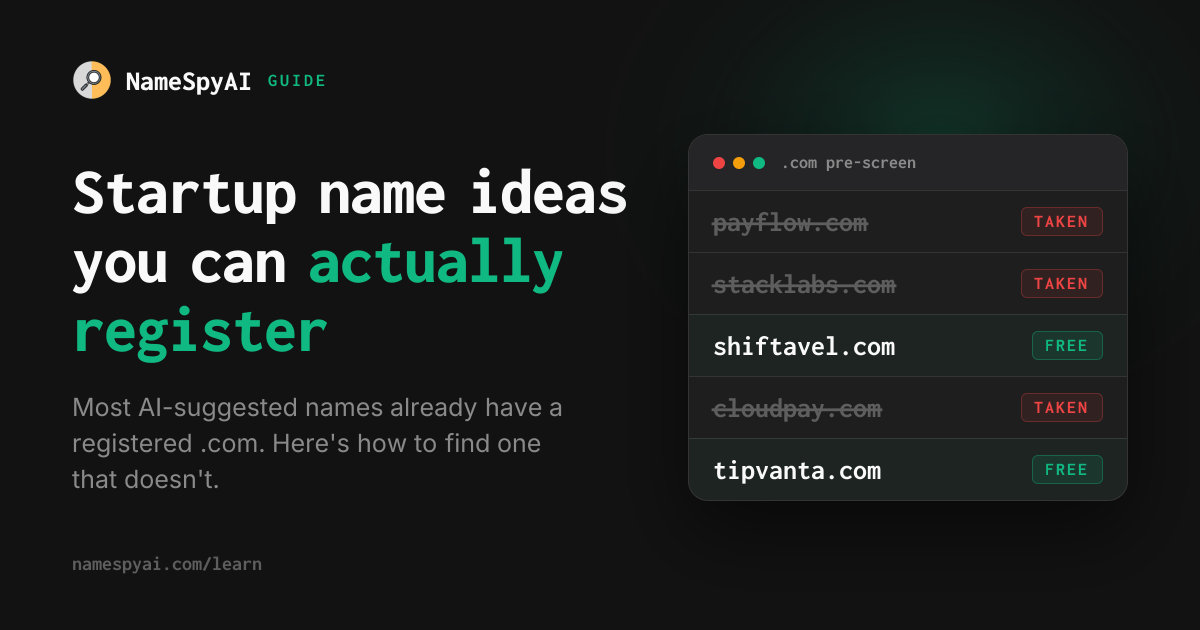
Most startup name ideas die on the domain. When we tested our own generator on 15 realistic startup descriptions, 60–90% of the names the AI suggested already had a registered .com. This guide covers how to get startup name ideas that survive that first check, how to judge a shortlist, and what to verify before you register the company.
Why most startup name ideas are already taken
Every short English word, most two-word compounds and nearly every four-letter .com were registered years ago. Startups make it worse because they reach for the same words: cloud, flow, stack, pay, labs, AI. A brainstorm that produces "PayFlow" or "StackLabs" feels productive until you type each one into a registrar and get the same answer twelve times.
The names that are still free tend to be built rather than found:
- Coined words. Google started as a misspelling of "googol". Nobody owned it because it didn't exist.
- Blends of two roots. Zillow combines "zillions" and "pillow". Groupon is "group" plus "coupon".
- Foreign or classical roots. Nvidia comes from the Latin "invidia" (envy).
- Altered spellings. Skype began as "Sky peer-to-peer", became "Skyper", and lost the "r" because skyper.com was taken.
That last story is how naming usually goes: the first idea is taken, and the final name is a tweak of it.
Where startup name ideas come from
Brainstorming on your own
Start with the words your customers use for the problem, not the words you use for the solution. A restaurant owner thinks about "shifts", "tips" and "covers", not "workforce management". Write down 30 of those words, then try combining, shortening and respelling them. Expect most results to be taken, and expect that to be useful: it tells you which roots are crowded.
Using a startup name generator
A generator is faster at the combining and respelling step, and that's most of the work. The catch is that most generators don't check anything. They return 50 names, you like six, and all six turn out to have a live .com or a company already using them.
Our startup name generator works the other way round. You describe the startup in one sentence, and it:
- Asks an AI model for about 40 candidates, steered toward coined and blended names because plain words are almost always registered.
- Drops names that are too long, contain digits or hyphens, or copy a famous brand.
- Checks each candidate's .com and hides the ones that are already registered.
- Runs a second batch if fewer than six names survive, telling the model which ideas were taken.
You get up to 12 names whose .com was unregistered when you searched. It's free, needs no signup, and you can run it six times every twenty minutes. A tech or software startup can pick the "Tech / software" option so the ideas fit a software company.
Asking people
Friends, advisors and early users are poor name generators but good name testers. Don't ask "what should we call it?" Give them three finalists and ask them to spell each one after you say it out loud. That test removes more bad names than any opinion.
How to write a prompt that gets better names
The description you give a generator matters more than the button you press. Compare:
- "fintech" gets you Finly, Paywise and Fintora, the same names every other fintech founder sees.
- "payroll software for small restaurants in India" gets names built from shifts, wages, kitchens and tips, and fewer of them are taken.
A good prompt says what the product does, who it's for, and, if it matters, where. Leave out adjectives like "innovative" or "modern". They don't narrow anything.
If the first list is close but not right, ask for more. The next batch leaves out the names you've already seen.
How to judge a shortlist
Generate as many ideas as you like, then cut to five. For each one, ask:
- Can someone spell it after hearing it once? Say it on a call. If you have to spell it out, so will every customer.
- Does it outgrow your first product? "ShiftPay" is fine until you add scheduling. Startups name a company, and the company usually changes direction at least once.
- Is it close to anything in your market? A name one letter away from a competitor will leak support tickets, reviews and search traffic forever.
- Does it need a prefix to work? If the only available domain is getname.com or namehq.com, count that as a cost, not a fix.
Keep the second-best name in view. A second choice that passes every check beats a favourite that needs three workarounds.
What a free .com doesn't tell you
A free .com is the first check, not the last. A name with an unregistered domain can still:
- clash with a live trademark in your industry, in the US or EU
- belong to an active company on LinkedIn, Crunchbase or Product Hunt
- have its GitHub organization or npm package taken
- be unavailable as a handle on X, Instagram or LinkedIn
The trademark one is the only conflict that can legally force a rename, and it's common. Our weekly Trademark Watch report tracks how many new Product Hunt launches carry a possible trademark conflict.
For a quick second pass, the free startup name checker looks at domains, GitHub, LinkedIn, Product Hunt and Crunchbase. For the names you're serious about, the full NameSpyAI check runs 15 checks in one search, including US and EU trademarks, both app stores, Google results and the major social handles, and turns them into one risk score with a plain-English verdict. The step-by-step version of all this is in how to validate a product name, and software founders should also read how to validate a SaaS name.
A simple naming process that works
- Write one sentence on what the startup does and for whom.
- Run it through the startup name generator three or four times, tweaking the description between runs.
- Add your own variations of the names you like.
- Cut to five names using the shortlist questions above.
- Run the free checker on all five and drop anything with a conflict in your market.
- Run the full check on your final two.
- Register the domain and the company the same day. Names that sit in a notes app get taken.
The whole thing fits into an afternoon. Renaming after launch takes months.
Frequently asked questions
What is a good startup name?
One that people can spell after hearing it, that has a domain you can own, and that nobody in your market already uses. It should describe the company you're building, not just your first product. Most good startup names are short coined words or blends because nearly all plain words are taken.
Are AI startup name generators any good?
They're good at volume and at combining roots, which is the slow part of naming. Most of them don't check whether names are available, so you end up shortlisting names you can't register. Use one that screens domains, and treat its output as raw material to edit, not a final answer.
Should a startup name describe what the company does?
Not literally. Descriptive names like "RestaurantPayroll" are hard to trademark and box you in when the product changes. A name that hints at the idea, the way Groupon hints at group coupons, is easier to protect and still easy to remember.
Do I need a .com for my startup?
No, but it helps. Many software companies launch on .io, .ai or .app without any trouble. What matters more is who holds the .com you don't have. A parked page is fine; an active company in your space means customers and email will go to the wrong place.
How do I check if a startup name is already taken?
Search the exact name on Google, LinkedIn, Crunchbase and Product Hunt, then check the domain, social handles and the USPTO and EUIPO trademark databases. Doing it by hand takes a few hours per name. The NameSpyAI check runs 15 of these checks in one search in about 15 seconds.
Is the NameSpyAI startup name generator free?
Yes. There's no signup, and you can run it six times every twenty minutes. The description you type is used to generate names and isn't saved to a database or linked to an account.